Moving from the UK to the UAE: the money checklist nobody hands you
Written and reviewed by Rocco Clayfield, Founder and Editor · Last reviewed: 29 August 2026
A Dubai salary is tax-free. Getting there cleanly is not. The UK doesn't simply forget you on the day you fly — and one missed form can mean paying tax you never owed. Here's exactly what to sort, in order.
Most people fixate on the headline: a salary in Dubai or Abu Dhabi lands with no income tax taken off the top. That part is true. The expensive mistakes happen at the join, in the weeks either side of your flight, where UK rules and UAE rules briefly overlap. Leaving the UK is not one decision. It is nine, and each one has its own form, its own deadline and its own way of costing you money if you miss it. Use the list below to go straight to the one you need.
When do you stop being UK tax resident?
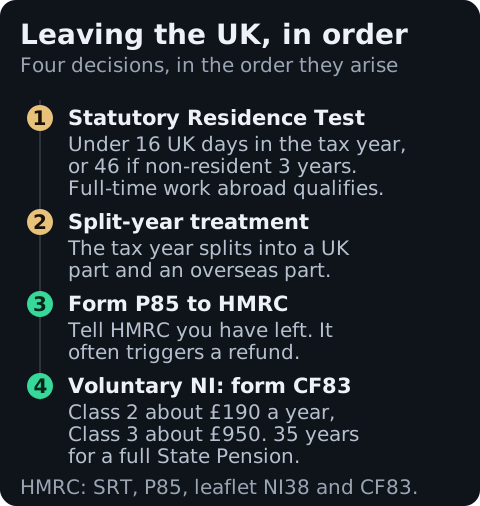
You stop being UK tax resident from the first day you meet an automatic overseas test, most often by spending fewer than 16 days in the UK in a tax year. HMRC sets this under the Statutory Residence Test.
Source: GOV.UK, Tax on foreign income: UK residence and tax. Checked 27 August 2026. The 16-day limit becomes 46 days if you were non-resident for all three previous tax years.
Your entire UK tax exposure hinges on one thing: residence. HMRC decides it with the Statutory Residence Test (SRT), and the test runs in three parts, applied in order.
First come the automatic overseas tests. The cleanest one for a mover: if you spend fewer than 16 days in the UK in a tax year (6 April to 5 April), you're automatically non-resident. If you were non-resident in all of the previous three tax years, that threshold rises to fewer than 46 days. And if you work full-time abroad — broadly 35+ hours a week averaged over the year, which a normal UAE job clears easily — you can be non-resident provided you keep UK days under 91 and UK workdays low. Most people relocating to the UAE for a job land here.
What does the Statutory Residence Test actually ask?
The test asks, in order, whether you meet an automatic overseas test, then an automatic UK test, then how your UK ties weigh against your days in the country. HMRC counts 5 possible ties.
Source: HMRC, RDR3: Statutory Residence Test. Checked 27 August 2026. The five ties are family, accommodation, work, the 90-day tie and, for leavers, the country tie.
If none of those apply, HMRC checks the automatic UK tests (for example, spending 183+ days in the UK makes you resident, full stop). If you're caught by neither set, you fall to the sufficient ties test, which counts your connections to the UK against the days you spend there.
There are five possible ties: a UK family tie (spouse, civil partner or minor children resident in the UK), an accommodation tie (a UK home available to you for 91+ days that you use), a work tie (40+ UK workdays), a 90-day tie (90+ UK days in either of the two prior years), and — for people leaving — a country tie (the UK is the country you're present in most). The more ties you keep, the fewer UK days you're allowed before residence snaps back. As a rough guide for a "leaver", four ties means roughly 16–45 days is your safe band; three ties stretches it to around 46–90; one or two ties gives you much more room. The arithmetic is unforgiving, so it pays to count days deliberately rather than guess.
Does split-year treatment apply when you leave mid-year?
Split-year treatment applies if you meet one of the 8 statutory cases, most commonly Case 1, starting full-time work overseas. The tax year then divides into a UK part and an overseas part.
Source: HMRC, RDR3: Statutory Residence Test, split-year guidance; the cases are set by Finance Act 2013, Schedule 45, Part 3. Checked 27 August 2026. Split-year is not automatic and is not a choice you tick.
The piece that makes a mid-year move work cleanly is split-year treatment. Instead of being taxed as resident for the whole year you leave, the year is split: you're treated as UK-resident up to your departure and non-resident afterwards, so your overseas earnings from the UAE side of the line aren't dragged into UK tax. The most common qualifying route for an employee is "starting full-time work overseas". You don't get split-year automatically — it has conditions around when you leave and how few UK days and UK workdays you have in the overseas part — so keep evidence: flight confirmations, your UAE tenancy contract and Ejari, your residence visa and Emirates ID dates, and your employment contract start date.
When does the P85 go in?
Send form P85 to HMRC after you have left the UK, using your departure date and the P45 from your final employer. Filing it reclaims PAYE overpaid across the 12 months the system assumed you would work.
Source: HMRC, Get your Income Tax right if you are leaving the UK (P85). Checked 27 August 2026. If you already file Self Assessment, HMRC may ask you to report the departure on that return instead.
The P85 is the form that formally tells HMRC you've left the UK. You file it after you've gone — you'll need your departure date, your last UK employer details, and your most recent P45 (parts 2 and 3) from that employer. You can submit it online through your Government Gateway account or by post.
The reason to do it promptly is money. UK PAYE is calculated as if you'll earn a full year's salary and receive your tax-free Personal Allowance spread evenly across all twelve months. If you leave part-way through the tax year, you've effectively had only part of the year's pay but the system has often over-taxed you on the assumption you'd keep earning. The P85 lets HMRC recalculate, apply the full year's Personal Allowance against your shorter run of UK earnings, and refund the overpaid PAYE — frequently a few hundred to a few thousand pounds depending on when in the year you left and your salary. It also formally registers your non-resident status, which matters for everything that follows.
One nuance: if you already complete a UK Self Assessment return — say you're a landlord — HMRC may tell you to declare your departure on that return instead of, or as well as, the P85. Either way, don't simply go quiet; tell them, in writing, that you've left and when.
Should you pay voluntary National Insurance, and which class?
Pay voluntary Class 2 if you qualify. It costs £3.65 a week in 2026/27 and buys a full qualifying year towards the new State Pension. HMRC confirms which class you may pay.
Source: GOV.UK, Voluntary National Insurance rates and Social Security abroad: NI38. Checked 27 August 2026. Class 3 costs £18.40 a week for the same qualifying year. Apply from abroad with form CF83.
When you stop paying UK National Insurance, you stop building entitlement to the new State Pension. The full new State Pension generally needs about 35 qualifying years of NI (and a minimum of around 10 years to get anything at all). Every qualifying year you keep adds roughly 1/35th of the full amount — so a year is genuinely valuable in retirement terms.
Start by checking your record. The quickest way is the official HMRC app or your personal tax account on GOV.UK, where you can see your years to date, any gaps, your forecast, and — crucially — which gap years you're allowed to fill and what each would cost. Do this before you do anything else; you may already have more years than you think, or fewer.
If there are gaps, you can often pay voluntary contributions from abroad, and there are two classes:
- Class 2 is the cheap one — a flat weekly rate of £3.65 in 2026/27, which is £189.80 for a whole year. To pay Class 2 while abroad you generally need to have been "ordinarily" employed or self-employed in the UK immediately before leaving and to be working while overseas (an employed UAE job typically counts). It's widely regarded as one of the best-value top-ups in the UK system because a qualifying year costing under £200 can add meaningfully to a lifetime pension.
- Class 3 is the fallback if you don't qualify for Class 2 — substantially more expensive at £18.40 a week, or £956.80 for a full year — but still often worth it given the lifetime payback.
To apply to pay voluntary NI from overseas you submit form CF83 (attached to leaflet NI38) to HMRC; they'll write back confirming which class you can pay and how. Decide this deliberately rather than letting years quietly lapse — the right to fill older gaps is time-limited, so a quick check now can save an irreversible loss later.
What happens to your UK rental income?
UK rental income stays UK-taxable wherever you live. Under the Non-Resident Landlord Scheme your agent or tenant deducts tax at the 20% basic rate unless HMRC approves form NRL1 to pay you gross.
Source: HMRC, Paying tax on rent on behalf of landlords who are abroad. Checked 27 August 2026. Where there is no letting agent, a tenant paying more than £100 a week must operate the scheme.
UK rental income stays fully UK-taxable however long you live abroad. Under the Non-Resident Landlord Scheme (NRLS), your letting agent (or your tenant, if there's no agent and the rent is over £100 a week) is required by default to deduct basic-rate tax from your rent before passing it on. You can stop that deduction by applying to HMRC with form NRL1 for approval to receive rent gross — you still declare the income and pay any tax due via Self Assessment, but you keep your cash flow and your allowable deductions (mortgage interest relief, agent fees, repairs) instead of having tax withheld up front. As a non-resident you also keep your UK Personal Allowance as a British citizen, so modest rental profits may attract little or no tax once expenses are set against them. Apply for NRLS approval before or as soon as you leave so the withholding never starts.
What happens to your ISAs when you move?
Existing ISAs stay open and keep their UK tax shelter. You may pay in £0 of new money for any tax year you are non-resident, though HMRC lets you resume the day you become UK-resident again.
Source: GOV.UK, Individual Savings Accounts: if you move abroad. Checked 27 August 2026. Crown employees working overseas, and their spouses or civil partners, are the exception.
ISAs can stay open and keep growing tax-efficiently while you're abroad, and the wrapper still shields UK tax on the gains and income inside it. The catch: you generally cannot pay new money in for any tax year in which you're non-resident. Don't close them in a panic and don't assume you have to sell up — leave existing ISAs intact, and remember that "tax-free in the UK" doesn't automatically mean tax-free wherever you live next if you move on from the UAE. The day you become UK-resident again, you can resume subscribing.
What happens to your UK pension when you move?
Your UK pension stays invested and keeps growing, and leaving it alone is usually right. Transferring it to a QROPS can trigger HMRC's overseas transfer charge of 25% of the transferred value.
Source: HMRC Pensions Tax Manual, PTM102200: essential principles of the overseas transfer charge. Checked 27 August 2026. Tax relief on new contributions largely depends on UK earnings you no longer have.
Pensions. Your existing workplace and personal pensions stay invested and keep growing; you don't need to do anything dramatic. You can usually keep contributing in a limited way for a few years after leaving (relief on contributions up to a modest annual cap, broadly available for the tax years shortly after departure), but the generous tax relief that made UK pension saving attractive largely depends on UK earnings, which you no longer have. Be very cautious about transferring a pension overseas (a QROPS): it can trigger a tax charge of 25% on the transfer in some circumstances, it's a magnet for unregulated, commission-driven "advisers" in expat hubs, and for most people the existing UK scheme is perfectly fine left where it is. Treat any cold approach offering to "free up" or "unlock" your pension as a red flag and take regulated UK advice first.
Do you pay UK Capital Gains Tax if you sell a UK property?
Non-residents still pay UK Capital Gains Tax on UK residential property. You must report the disposal and pay through HMRC's UK property account within 60 days of completion, even when no tax is due.
Source: HMRC, Tell HMRC about Capital Gains Tax on UK property or land if you are not a UK resident. Checked 27 August 2026. The 60-day rule applies to completions on or after 27 October 2021.
Capital Gains Tax on UK property. Non-residents still pay UK CGT when they sell UK residential property, and the reporting deadline is tight: you must report the disposal and pay any tax due within 60 days of completion using HMRC's non-resident CGT / UK property account — even if no tax is owed, the report itself can be required. Only the gain since April 2015 is typically charged for property held before then (you can choose a rebasing method), but the 60-day clock is the trap people miss. If a UK sale is on the horizon, plan for it before you exchange.
What tax do you pay once you live in the UAE?
You pay 0% personal income tax on a UAE salary. VAT and corporate tax exist but neither lands on employment income, and end-of-service gratuity starts accruing once you complete one year under Federal Decree-Law No. 33 of 2021.
Source: UAE Legislation, Federal Decree-Law No. 33 of 2021, Article 51. Checked 27 August 2026. VAT is 5% on most spending; corporate tax of 9% applies only to business profit above AED 375,000.
Once you're resident in the UAE the tax picture is refreshingly short. There is no personal income tax on your salary — 0%. There's VAT at 5% on most spending, which you pay quietly at the till rather than through a return. Corporate tax of 9% exists, but only on business profit above AED 375,000, so it's a concern for company owners and some freelancers, not for ordinary employees. And from your first year you start accruing a legal end-of-service gratuity, which you can price with our UAE end-of-service gratuity calculator.
The gratuity is worth understanding before you sign, because how your offer is structured changes what you eventually walk away with. Under UAE Federal Decree-Law No. 33 of 2021, gratuity is calculated on your basic salary only — not your housing, transport or other allowances — at 21 days' basic pay for each of your first five years and 30 days' basic pay for each year after that, capped at a total of two years' wage, payable after a minimum of one year's service and due within 14 days of your end of service. The practical lesson: an offer that loads everything into allowances and keeps "basic" small looks generous on the headline but quietly shrinks your gratuity. Negotiating a higher basic — not just a higher total — compounds in your favour over the years. If you're in the DIFC, note that it runs the DEWS workplace savings scheme instead of the classic gratuity, and other free zones (JAFZA, DMCC, ADGM) vary, so check which regime your employer sits under. Our decode-my-offer tool separates the basic from the allowances so you can see the real shape of a package. One point worth knowing before you go: being dismissed does not forfeit the money. Article 39 of the same law lists dismissal among the disciplinary penalties while expressly preserving the worker's right to end-of-service gratuity, which our guide to what happens to your gratuity after dismissal sets out in full.
The genuine catch in the UAE isn't tax — it's the cost of living. School fees, villa or apartment rent (often payable in a small number of large cheques), car, utilities and the lifestyle creep that catches new arrivals can swallow a tax-free uplift faster than you'd expect. Run your number against UK reality with our "Am I Better Off?" calculator using real rent and school figures, not optimistic ones, before you accept. A deeper walk-through of payslips, allowances and gratuity once you're here lives on our already-working-in-the-UAE guide.
How much does moving money into dirhams really cost?
The exchange-rate margin, not the advertised fee, is where the money goes. The dirham is pegged to the US dollar at AED 3.6725, so the pound/dirham rate moves with sterling against the dollar.
Source: Central Bank of the UAE, the dirham/dollar peg. Checked 27 August 2026. Compare the dirhams that arrive against the pounds that left, not the headline rate.
This is the step that's invisible until it costs you. Between your UK salary, your relocation lump sum, school-fee transfers and eventually moving savings home, you'll move serious money across the £/AED line — and the spread your bank takes on the exchange rate can quietly cost more than the UAE's 5% VAT ever will.
As an indicative rate, £1 is roughly AED 4.95 (August 2026), though the rate moves daily and the figure here is educational, not a quote. The number that actually hits your account, though, depends less on the headline rate than on the margin baked into it. High-street banks frequently apply an FX markup of a couple of percent and sometimes add a flat transfer fee on top; on a £50,000 relocation transfer, two percent is £1,000 gone before you've bought a sofa. Specialist transfer services typically charge a fraction of that and show you the rate transparently.
A few practical moves:
- Open the right accounts early. Set up a UAE account once your residence visa and Emirates ID come through (you usually need them), and keep a UK current account open for your pension, any rental income and standing commitments. Some expats also use a multi-currency or international account to hold both £ and AED and convert when the rate suits.
- Don't convert everything on day one. If you can, stagger large transfers rather than dumping a lump sum at whatever rate happens to apply the week you land. Where a big known cost is coming (a year's school fees, a rent cheque), a forward arrangement can lock today's rate so a swing doesn't blow your budget.
- Compare the all-in cost, not the advertised rate. Always look at how many dirhams actually arrive for your pounds after every fee and margin — that's the only number that matters.
- Mind the AED's dollar peg. The dirham is pegged to the US dollar, so £/AED moves mainly with sterling against the dollar. That makes the timing of your transfers, rather than UAE policy, the thing that swings your money.
What do you need to sort in your first 90 days?
Sequence matters: entry permit, medical and biometrics, residence visa, Emirates ID, then bank account. That is 5 steps in that order, and UAE salaries must then be paid through the Wages Protection System.
Source: MOHRE, the Wages Protection System, and the UAE Government portal on residence and entry procedures. Checked 27 August 2026. Your Emirates ID is what unlocks banking, tenancy and utilities.
The paperwork on arrival has a logical order, and getting it in sequence avoids the limbo where you can't rent, bank or get paid properly. Broadly, it runs:
- Entry and medical. You'll typically enter on an employment entry permit, then complete a medical fitness test and biometrics as part of the residence process.
- Residence visa and Emirates ID. Your employer sponsors your residence visa; the Emirates ID is the card that unlocks almost everything else — bank account, mobile contract, tenancy, utilities. Chase your PRO or HR if it stalls.
- Bank account and salary (WPS). UAE salaries are paid through the Wages Protection System, so your employer needs your account details to pay you compliantly. Open the account as soon as your Emirates ID allows.
- Housing and Ejari. Rent is often paid in one to four cheques for the year, so have funds positioned. In Dubai, registering your tenancy (Ejari) is needed to connect utilities (DEWA) and set up internet.
- Driving and the rest. UK licence holders can usually convert to a UAE licence without re-sitting the test; sort this early if you'll drive.
On the money side, the first three months are where good habits pay off. Keep your UK affairs tidy from afar: confirm your P85 has been processed, check the first non-resident payslips of any UK rental income aren't being over-withheld, and diarise your NI decision so it doesn't drift. And keep counting your UK days from the moment you leave — the SRT runs on the whole tax year, so a casual fortnight back at Christmas can matter more than it feels like it should. If anything about your residence position, your offer's basic-vs-allowances split, or your transfers feels uncertain, that's exactly the point to ask before money moves.
What should you do before you fly?
10 actions, in order: confirm your SRT position, gather evidence, file the P85, check your NI record, register under the Non-Resident Landlord Scheme, leave ISAs alone, map any CGT, and open accounts early.
Each item below links back to the section above that explains it. Checked 27 August 2026.
- ☐ Confirm your leaving date and SRT position (automatic overseas test or split-year?)
- ☐ Gather evidence: flights, UAE tenancy/Ejari, visa and Emirates ID dates, contract start
- ☐ File your P85 with HMRC (have your P45 ready) and chase the refund
- ☐ Check your NI record on the HMRC app; decide on Class 2 vs Class 3 and submit CF83 if topping up
- ☐ Register UK rental income under the Non-Resident Landlord Scheme (form NRL1) to receive rent gross
- ☐ Leave ISAs open (no new subscriptions while non-resident); review pensions and resist QROPS sales pitches
- ☐ Map any UK property CGT exposure and the 60-day reporting deadline before you sell
- ☐ Open UK and UAE accounts; line up a low-margin currency provider and stagger big transfers
- ☐ Negotiate your UAE basic salary up, not just the total (bigger gratuity)
- ☐ Run the better-off calculator with real school and rent figures
This guide is educational and based on published UK and UAE rules current for 2026/27. It isn't financial, tax or legal advice, and PayslipIQ UAE isn't a regulated adviser. Individual circumstances vary — for a binding answer, speak to a UK-qualified accountant or a UAE adviser, and read more about how we work. We do not appoint, recommend or refer advisers and we receive nothing if you engage one, but ask us on WhatsApp and we will tell you what kind of professional your question needs.
Moving-from-the-UK FAQs
When do I actually stop paying UK tax on my salary?
Do I have to tell HMRC I've left, and how?
How many days can I spend back in the UK without becoming resident again?
Is it worth paying voluntary National Insurance from the UAE?
Can I keep my UK rental property, and how is it taxed?
What happens to my ISAs and pensions when I move?
If I sell my UK home while living in the UAE, do I owe tax?
How big a difference does my UAE basic salary make to my gratuity?
Sort it before you fly
Send us your situation on WhatsApp and we will point you to the sections above, and the official HMRC forms, that apply to it. Free. For advice you can act on, you need a qualified adviser.
💬 Ask which sections apply to me →