Already in the UAE? Run the money health-check
Written and reviewed by Rocco Clayfield, Founder and Editor · Last reviewed: 29 August 2026
You've made the move. Now make sure the package is fair, the gratuity is mounting up correctly, and the UK isn't quietly still taxing you. Ten questions, ten minutes.
How do you check the gratuity you are owed?
Gratuity is calculated on basic salary only, never on allowances. You earn 21 days of basic pay for each of your first five years of service under Article 51 of Federal Decree-Law No. 33 of 2021.
Source: UAE Legislation, Federal Decree-Law No. 33 of 2021, Article 51. Checked 27 August 2026. Years beyond the fifth earn 30 days each, and the total is capped at two years' wage.
Your end-of-service gratuity is a legal right under Federal Decree-Law No. 33 of 2021, and it is calculated on basic salary only: 21 days' basic pay for each of the first five years, then 30 days' basic pay for every year after that, capped at two years' total wage, with a minimum of one full year of service required to qualify at all. The single most important word in that sentence is basic. Housing, transport, utilities, schooling and "general" allowances do not count towards the calculation, even though they land in your bank account every month.
Here is how the formula actually feels in practice. Take your monthly basic, divide it by 30 to get a daily basic rate, then multiply by 21 for each of the first five years and by 30 for each subsequent year. So someone on a basic of AED 12,000 earns roughly 21 × (12,000 ÷ 30) = AED 8,400 of gratuity per year for the first five years — about AED 42,000 after five years — and then accrues at the faster 30-day rate thereafter. The arithmetic is simple; the trap is the figure you feed into it.
That trap is the basic-versus-allowance split. Two people can both earn a headline AED 30,000 a month and walk away with completely different gratuities. If your contract sets basic at AED 9,000 and loads AED 21,000 into allowances, your gratuity accrues on AED 9,000. If a colleague on the same AED 30,000 has basic set at AED 18,000, theirs accrues on double the figure — and after several years that gap runs into tens of thousands of dirhams. Same monthly pay, same tax (zero), very different end-of-service cheque.
How to verify it is accruing on the right basic. First, find the basic figure on your signed MOHRE or DIFC employment contract and on your monthly payslip — the two should match. Second, check that "basic salary" is the line being used, not "total salary" or "gross". Third, confirm your length of service is being counted from your actual joining date, including any probation, since probation counts towards service. Fourth, if you've had a raise, check whether your basic went up or only your allowances — because only a higher basic grows your gratuity. Put your real basic and dates into the gratuity calculator and compare the result against what your employer says you've banked.
What do DIFC and ADGM change about your end-of-service pay?
DIFC replaces accrued gratuity with the DEWS workplace savings plan, into which your employer pays 5.83% of basic salary each month for your first five years. ADGM runs its own separate employment regulations.
Source: DIFC, Employee Workplace Savings (DEWS), and ADGM Employment Regulations. Checked 27 August 2026. The DIFC core rate rises to 8.33% of basic after five years of service.
Mainland UAE follows the standard Labour Law gratuity described above. But where you are licensed matters enormously, because some free zones run completely different end-of-service schemes — and if you assume the mainland formula applies when it doesn't, you'll badly mis-estimate what you're owed.
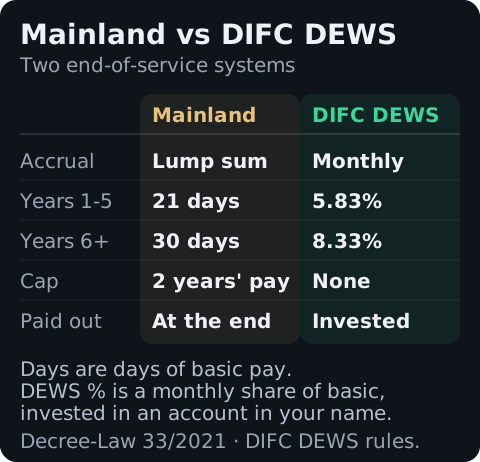
DIFC (Dubai International Financial Centre) replaced traditional accrued gratuity with the DEWS workplace savings plan. Instead of a lump sum calculated at the end, your employer pays a monthly contribution into a funded, invested account on your behalf — typically 5.83% of basic for the first five years of service and 8.33% thereafter, mirroring the old day-count rates but paid as you go rather than at the end.
ADGM (Abu Dhabi Global Market) operates its own employment regulations and has its own end-of-service savings arrangements; check whether you're on a funded scheme or a traditional gratuity entitlement.
What to check on a DEWS statement. Because DEWS is funded monthly, the thing to police is the contributions, not a final formula. Open your DEWS member statement and confirm three things. One, that contributions are actually arriving every month and haven't quietly stopped — a lapse is the most common problem. Two, that each contribution is calculated on the correct basic (again, not total pay), at the right percentage for your length of service, and that the rate stepped up after five years. Three, which investment option your pot sits in — the default cash-style fund is low-risk but low-growth, and you can usually switch to a higher-growth fund if your time horizon suits it. Your DEWS pot is portable and stays invested between jobs, which is a genuine advantage over a classic gratuity that only crystallises when you leave — but only if the contributions are correct in the first place.
Does working in a free zone change your gratuity entitlement?
Free-zone employment does not remove your gratuity. JAFZA, DMCC and most zones apply the same 21-day Article 51 formula as the mainland, and only the administering authority and the paperwork differ.
Source: UAE Legislation, Federal Decree-Law No. 33 of 2021, Article 51. Checked 27 August 2026. DIFC and ADGM are the exceptions: each runs its own employment regime rather than the federal formula.
Other free zones — JAFZA (Jebel Ali), DMCC, and others on the Dubai/Sharjah/Northern Emirates side — generally apply the standard mainland gratuity formula, but the administering authority and the exact end-of-service paperwork differ. Don't assume the process is identical to a mainland MOHRE employer.
Tell us your zone and licensing authority on WhatsApp and we will point you to the published rules that govern your end-of-service money and to what your statement should show.
Does UK tax still follow you to Dubai?
Living in Dubai does not make you non-resident by itself. HMRC decides under the Statutory Residence Test, UK rental income stays taxable wherever you live, and UK property disposals must be reported within 60 days.
Source: GOV.UK, UK residence and tax, and HMRC, Capital Gains Tax for non-residents on UK property. Checked 27 August 2026.
Living tax-free in the UAE is only half the picture. The other half is making sure HMRC agrees you've genuinely left — because "I moved abroad" is not the same as "I'm non-resident for UK tax". If you moved without filing a P85 or properly working out your position under the Statutory Residence Test (SRT), you could still be on HMRC's books, and a chunk of your income could still be UK-taxable even while you sit in Dubai.
The SRT ties that catch people out. Once you've left, the SRT looks at how many days you spend in the UK and how many "ties" you keep. Each tie lowers the number of UK days you're allowed before you flip back to UK-resident: a tie for available UK accommodation, a tie for UK work, a family tie, a 90-day tie, and — for recent leavers — a country tie. The practical message is that frequent trips home add up fast, and the more ties you've retained, the fewer days you can spend in the UK before residence reattaches. Split-year treatment can cleanly divide the year you left into a UK part and an overseas part, but only if you meet the conditions, which is exactly why getting the date and the filing right matters. There's a fuller walk-through, including the day-count thresholds, in our Statutory Residence Test section.
The loose ends most expats leave behind. A retained UK home is the classic one — keeping a property you can live in is both an SRT accommodation tie and a magnet for trips back. UK rental income stays UK-taxable wherever you live: if you're letting out a property, you should register under the Non-Resident Landlord Scheme so your agent or tenant doesn't have to deduct basic-rate tax before paying you, and you'll still file a UK return on the rental profit. If you sell UK residential property while non-resident, non-resident Capital Gains Tax applies and must be reported to HMRC within 60 days of completion, even if no tax is due. And ISAs keep their tax-free status while you hold them, but you generally can't pay new money in once you're non-resident. It's worth a ten-minute audit against our moving-from-the-UK guide — and if anything looks unresolved, message us and we'll tell you what kind of qualified professional the question needs.
Is your State Pension still growing while you are abroad?
Your National Insurance record stops building the day you leave the UK. The full new State Pension needs about 35 qualifying years, and voluntary contributions from abroad keep the count moving.
Source: GOV.UK, Check your State Pension forecast and Voluntary National Insurance rates. Checked 27 August 2026. Class 2 costs £3.65 a week in 2026/27 against £18.40 for Class 3.
This is the cheapest big win available to most British expats, and the one most often missed. The moment you stop paying UK National Insurance, your NI record stops building — and the new State Pension needs roughly 35 qualifying years for the full amount, with at least 10 years to get anything at all. Every year you spend in the UAE not contributing is potentially a year missing from that record.
Class 2 versus Class 3 — and why it matters so much. If you were employed or self-employed in the UK immediately before leaving and meet HMRC's conditions, you may be able to pay voluntary Class 2 contributions from abroad. Class 2 is dramatically cheaper than Class 3 — both buy you the same qualifying year towards your State Pension, so where you qualify for Class 2 it is often outstanding value, frequently recouped many times over across a normal retirement. Class 3 is the fallback for those who don't meet the Class 2 conditions; it still works, just at a higher weekly cost. You can also usually fill in some past gaps as well as keep current years topped up, though there are time limits on how far back you can go.
Do this on purpose, not by accident. Start by getting your State Pension forecast and full NI record from GOV.UK so you can see exactly how many qualifying years you already have and where the gaps are. Then apply to HMRC to pay voluntary contributions from abroad and confirm which class you qualify for. The decision is genuinely individual — it depends on your years to retirement, your existing record and your plans — so treat the numbers as your starting point and take advice before committing larger sums.
How much are you losing on money transfers?
The exchange-rate margin, not the advertised fee, is the real cost of sending money home. The dirham is pegged to the US dollar at AED 3.6725, so sterling against the dollar drives your rate.
Source: Central Bank of the UAE, the dirham/dollar peg. Checked 27 August 2026. Compare the pounds that arrive against the dirhams that left, not the headline rate.
You've moved somewhere with 0% income tax. The irony is that the silent tax you're most likely paying now is the spread on moving money between dirhams and pounds. Sending money home or repatriating savings through your bank's default FX can cost more over a year than the UAE's 5% VAT ever will — because the cost hides in a poor exchange rate rather than showing as a fee.
Where the money leaks. Three places. The FX margin: banks build a few percent into the rate versus the real mid-market rate, so a "no fee" transfer can still be the expensive option. Flat fees, which bite most on small or frequent transfers. And timing: a few percent swing on a large transfer dwarfs any fee. In mid-2026 the rate sits around £1 ≈ AED 4.95, but treat that as an educational snapshot — check the live rate before you move anything sizeable.
Transfer discipline that saves money. Compare the dirhams leaving your account against the pounds landing in the UK — that all-in figure is the only number that matters, not the advertised fee. Use a specialist money-transfer provider rather than a bank counter for anything beyond pocket money, and on large one-off moves compare a couple of providers on the day. Ask us on WhatsApp how to compare providers on the all-in cost. We take no commission from any of them.
What should you watch on savings, pensions and insurance?
Health cover is mandatory for UAE residents. On the UK side, moving a pension into a QROPS can trigger HMRC's overseas transfer charge of 25% of the transferred value, so leaving the existing scheme alone is usually cheaper.
Source: HMRC Pensions Tax Manual, PTM102200: essential principles of the overseas transfer charge. Checked 27 August 2026. Your residence visa is sponsored by your employer, so the job and the visa end together.
The hardest habit to build on a tax-free salary is actually keeping the money you're no longer handing to HMRC. The danger is lifestyle creep: a bigger net packet quietly becomes a bigger spend, and three years later there's little to show for the move. Decide your savings rate before the money arrives and automate it on payday, so the tax-free uplift turns into a growing pot rather than a nicer brunch.
Where to be careful. Expats here are frequently sold long-term, locked-in "savings plans" and offshore investment bonds with heavy upfront charges and brutal early-exit penalties — very profitable for the salesperson, rarely the best deal for you. Be wary of anything tying up your money for 15 or 25 years, anything paying the adviser a large commission, and any pressure to act quickly; low-cost, transparent, flexible vehicles almost always win. On the UK side, leaving your existing workplace or personal pension where it is, fully invested, is often perfectly sensible — transferring it overseas into a QROPS is a big, sometimes irreversible decision with tax and charge implications, so treat any QROPS pitch with real caution and get independent advice first.
Insurance and the safety net. Health cover is mandatory for residents, but check what your employer's policy actually includes — maternity, dependants, and cover outside the UAE are common gaps. If anyone relies on your income, consider adequate life and income-protection cover on a clean, term basis rather than bundled into an expensive investment wrapper. And keep an accessible cash emergency fund: in a country where your visa is tied to your job, a few months' expenses on hand is not optional. For a steer on what "good" looks like without a sales pitch, message us and we will tell you what kind of professional to look for. We do not appoint, recommend or refer advisers, and we receive nothing if you engage one.
What should you check before you resign?
Work out your gratuity before you hand in notice, so you can check the settlement instead of accepting it. Notice under Article 43 of Federal Decree-Law No. 33 of 2021 runs between 30 and 90 days.
Source: UAE Legislation, Federal Decree-Law No. 33 of 2021, Article 43. Checked 27 August 2026. Your contract sets the exact period inside that statutory range.
Changing jobs in the UAE is where end-of-service money is most often lost — not through anything dramatic, but through resigning before you understand your own entitlements. Run through this before you hand in notice.
- Serve and confirm your notice correctly. Your notice period is set in your contract (commonly 30 days, but check yours). Resign in writing, keep a copy, and confirm your last working day so service is counted to the right date — that date drives your gratuity.
- Know your gratuity number first. Under Federal Decree-Law No. 33 of 2021 your earned gratuity is payable once you've completed one full year of service, calculated on basic salary as above. Work out the figure yourself with the gratuity calculator before you leave, so you can check the final settlement rather than accepting whatever lands.
- The 14-day settlement rule. Employers are required to settle end-of-service dues within 14 days of the end of the employment relationship. That settlement should include your gratuity, any unpaid salary, and payment for accrued-but-untaken annual leave. If it's late or short, that's a flag worth raising.
- Labour ban myths. The old fear of an automatic "labour ban" for resigning is largely outdated under the current law — limited-term contracts and proper notice changed the picture, and moving between employers is normal. Don't let outdated WhatsApp-group folklore pressure you into a bad decision; check your actual contract terms instead.
- Visa cancellation and the grace period. Your residence visa is tied to your employer, so leaving triggers visa cancellation and a grace period before you must have a new visa or exit. Time your move so you don't fall out of status, and make sure your final settlement is paid before you sign anything cancelling your visa.
If you're weighing an offer against your current package, the Better Off? calculator and Decode My Offer will show you the real net comparison, basic-and-all.
How long does your employer have to pay your final settlement?
Your employer must pay your wages and all other entitlements within 14 days of the contract ending. Article 53 of Federal Decree-Law No. 33 of 2021 sets that deadline, and it covers gratuity and untaken leave.
Source: UAE Legislation, Federal Decree-Law No. 33 of 2021, Article 53, which requires payment "within fourteen (14) days as of the date of the end of the contract". Checked 27 August 2026.
The deadline is statutory, not a courtesy. It covers your end-of-service gratuity, any unpaid salary, payment for accrued but untaken annual leave, and anything else your contract owes you. Two practical points follow. The clock runs from the end of the contract, not from the day your visa is cancelled and not from the day HR gets to it. And the figure is much easier to challenge if you already hold it: work it out before you leave with our UAE end-of-service gratuity calculator, so you are checking the settlement against a number of your own rather than accepting whatever arrives.
What do you do if your employer underpays your gratuity?
Put the shortfall in writing to your employer, then register a labour complaint with MOHRE. Unresolved private-sector disputes are referred onward, and the 14-day payment deadline in Article 53 is the evidence you lean on.
Source: MOHRE, Register labour complaints, private sector employees, and Federal Decree-Law No. 33 of 2021, Article 53. Checked 27 August 2026.
Start with the paperwork rather than the argument. Set out, in writing and dated, your basic salary, your joining date, your last working day and the figure you make it. That single document does more work than any phone call, because it fixes what you asked for and when you asked for it.
If that does not resolve it, MOHRE takes labour complaints from private-sector employees directly. Take your signed contract, payslips showing the basic figure, and your start and end dates. One myth worth killing before it costs you: being dismissed does not remove the entitlement. Article 39 lists dismissal among the disciplinary penalties while expressly preserving the worker's right to end-of-service gratuity. The forfeiture rule people still repeat belonged to Articles 120(e) and 139(1) of the repealed Federal Law 8 of 1980. Our guide to gratuity after dismissal sets out the full position.
Educational guidance based on published UAE and UK rules for 2026/27. Not financial, tax or legal advice. For your specific zone, contract or UK position, speak to a qualified adviser — and read more about how we work. We do not appoint, recommend or refer advisers and we receive nothing if you engage one, but ask us on WhatsApp and we will tell you what kind of professional your question needs.
Working-in-the-UAE FAQs
Is my gratuity calculated on my total salary or just my basic?
How is the 21-day and 30-day gratuity formula worked out?
I'm in DIFC — do I get gratuity or DEWS?
Do other free zones like JAFZA, DMCC or ADGM use the same rules?
I live in Dubai — do I still owe any UK tax?
Should I pay voluntary National Insurance while I'm abroad?
What's the cheapest way to send money back to the UK?
What should I check before I resign or change employer?
Work out your number before you resign
Send your package and dates on WhatsApp. We will show you how Article 51 applies to them and what to check on your contract and payslip. We do not issue a final figure: your employer's settlement is the number that counts.
💬 Ask about my gratuity →